Finished July 31
The Age of Miracles by Karen Thompson Walker
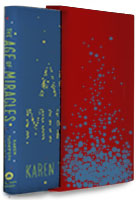
This novel started from a bit of news, one I also had noted and wondered at. The news was that we had to add a second to the year to adjust for a change in the time of rotation. Walker took that idea, and ran with it. In this novel, the change is much more than a second, and it goes on increasing each day, leading to huge societal changes. At the centre of the book is Julia, 11 years old and living in California. Julia finds that relationships change. She has never had a lot of friends, but the change in time leads quickly to changes in her friendships. She also sees it in the relationships of those around her. As the novel progresses and the changes accummulate, we see the effect they have.
Some people try to stick to doing things with the sun, even as the days grow impossibly long and create communities apart from the rest of society. Julia adjusts to doing things in the dark sometimes and sleeping in the light. We see the effect on energy use and food supply. We see how people are trying to find solutions even as they don't know the cause of the "slowing".
I found myself drawn in to Julia and her experiences, particularly those around friendships and her relationship with her grandfather. When she struggles with whether to keep secrets, I identified with her conflicted feelings. Along with everything else, Julia is experiencing her first love, and trying to figure out how to behave about it. She is a very engaging young woman who has interesting observations on the world as it is changing.
I was lucky to get an Indiespensable copy of this, in a nicely boxed edition, which included an interview with the author, providing interesting background to her process in the creation of this novel.
A great read that gets you thinking, what would I do? I think this book would appeal to teens as well as adults.
Tuesday, 31 July 2012
Sunday, 29 July 2012
Just the Rules
Finished July 29
Just the Rules: Tosca's Guide to Eating Right by Tosca Reno
This short guide is a portable tool for following the Eat-Clean Diet regime. Each rule is listed with short explanations and a sense of humour. This is common sense told in a plain and simple, straightforward manner. All of it makes sense, and so do the reasons behind it. A great overview of eating healthy.
Just the Rules: Tosca's Guide to Eating Right by Tosca Reno
This short guide is a portable tool for following the Eat-Clean Diet regime. Each rule is listed with short explanations and a sense of humour. This is common sense told in a plain and simple, straightforward manner. All of it makes sense, and so do the reasons behind it. A great overview of eating healthy.
Mission to Paris
Finished July 28
Mission to Paris by Alan Furst
It is 1938 and Hollywood actor Fredric Stahl is sent by Warner to Paris to make a movie for Paramount France. Stahl was born in Austria, loves Paris, and is not a fan of the Nazis. But the Nazis seem his as a perfect agent of influence for them and use charm, cajoling and threats to get him to look, act or do things on their behalf. Stahl can sense what is going on, although not the extent of what they'll do. He finds himself informed of his vulnerability by the American embassy and can't stand to just avoid, but must also work actively against them. As things get more dangerous and his film responsibilities take him to Morocco and Hungary, he learns more and gets himself into more dangerous situations. He also finds himself attracted to a young Parisian socialite and an emigre.
This is a story of the lead-up to World War II, the city of Paris, and the loyalties of a man to those who helped him create the life he now leads.
Furst is a master of the spy novel, and I thoroughly enjoyed it.
Mission to Paris by Alan Furst
It is 1938 and Hollywood actor Fredric Stahl is sent by Warner to Paris to make a movie for Paramount France. Stahl was born in Austria, loves Paris, and is not a fan of the Nazis. But the Nazis seem his as a perfect agent of influence for them and use charm, cajoling and threats to get him to look, act or do things on their behalf. Stahl can sense what is going on, although not the extent of what they'll do. He finds himself informed of his vulnerability by the American embassy and can't stand to just avoid, but must also work actively against them. As things get more dangerous and his film responsibilities take him to Morocco and Hungary, he learns more and gets himself into more dangerous situations. He also finds himself attracted to a young Parisian socialite and an emigre.
This is a story of the lead-up to World War II, the city of Paris, and the loyalties of a man to those who helped him create the life he now leads.
Furst is a master of the spy novel, and I thoroughly enjoyed it.
Wednesday, 25 July 2012
On an Irish Island
Finished July 24
On an Irish Island by Robert Kanigel
This book looks at the legacy of the Blaskets, islands in the north west of Ireland. As the Irish language was vanishing throughout Ireland, these islands drew scholars and writers to them. A pocket where Irish was still the language spoken daily, this area drew a variety of visitors that elevated the islands both nationally and internationally. From J.M. Synge, the playwright to Carl Marstrander, a Norwegian linguist, the area drew both writers and scholars of the Irish language.
Some of these visitors encourage the local inhabitants to write of their lives as well, creating a body of work about their lives that is still studied.
I hadn't been aware of the role this area played in Irish nationalism, language, and literature. Part of their legacy is the language that is still spoken and studied today, but the Blaskets also represented a dying way of life with the move from rural to urban, the growth of modern conveniences, and the decline of community.
A very interesting study that provides many insights.
On an Irish Island by Robert Kanigel
This book looks at the legacy of the Blaskets, islands in the north west of Ireland. As the Irish language was vanishing throughout Ireland, these islands drew scholars and writers to them. A pocket where Irish was still the language spoken daily, this area drew a variety of visitors that elevated the islands both nationally and internationally. From J.M. Synge, the playwright to Carl Marstrander, a Norwegian linguist, the area drew both writers and scholars of the Irish language.
Some of these visitors encourage the local inhabitants to write of their lives as well, creating a body of work about their lives that is still studied.
I hadn't been aware of the role this area played in Irish nationalism, language, and literature. Part of their legacy is the language that is still spoken and studied today, but the Blaskets also represented a dying way of life with the move from rural to urban, the growth of modern conveniences, and the decline of community.
A very interesting study that provides many insights.
Sunday, 22 July 2012
The Iron King
Finished July 22
The Iron King by Julie Kagawa
This is the first novel in the Iron Fey series. Meghan Chase is about to turn sixteen and yet the only ones who seem to notice are her four-year-old stepbrother Ethan and her friend Robbie. Meghan has never quite fit in, something she has felt keenly since her father disappeared when she was six. Now she seems to be noticing odd things like the creature near the computer at school. Ethan is scared of things in his closet and Meghan finds herself wondering what she sees when she looks in too.
When she arrives home from school on her birthday, she finds things changed, particularly her brother. Robbie soon arrives, but when he reveals what she must do to find her brother, she has trouble believing it. Once she arrives in the world of faeries, Meghan learns of the many creatures and dangers awaiting her and finds the truth of her existence, the child of a faery king and a human, someone to be fought after. Her heart leads her both to her brother and towards the mystical faery prince Ash, but will she be able to save Ethan?
Lots of interesting fantasy elements. I always find it interesting to see different authors portrayal of the world of faery and its creatures and this one doesn't disappoint. There is a great story here, with danger, romance, and a girl coming into her own power.
The Iron King by Julie Kagawa
This is the first novel in the Iron Fey series. Meghan Chase is about to turn sixteen and yet the only ones who seem to notice are her four-year-old stepbrother Ethan and her friend Robbie. Meghan has never quite fit in, something she has felt keenly since her father disappeared when she was six. Now she seems to be noticing odd things like the creature near the computer at school. Ethan is scared of things in his closet and Meghan finds herself wondering what she sees when she looks in too.
When she arrives home from school on her birthday, she finds things changed, particularly her brother. Robbie soon arrives, but when he reveals what she must do to find her brother, she has trouble believing it. Once she arrives in the world of faeries, Meghan learns of the many creatures and dangers awaiting her and finds the truth of her existence, the child of a faery king and a human, someone to be fought after. Her heart leads her both to her brother and towards the mystical faery prince Ash, but will she be able to save Ethan?
Lots of interesting fantasy elements. I always find it interesting to see different authors portrayal of the world of faery and its creatures and this one doesn't disappoint. There is a great story here, with danger, romance, and a girl coming into her own power.
I am Number Four: The Lost Files: The Legacies
Finished June 20
I am Number Four: the Lost Files: the Legacies by Pittacus Lore
This book originally was only available as an ebook, but has now been put together in one volume. It includes the Lost Files, which consists of the back stories of Six and Nine; and it includes the Legacies, which is what happened to One, Two, and Three. Here, there is a bit of a twist, in which we see some of the story from a Mogadorian viewpoint. This provides an interesting vantage point, and I'm sure will figure in the developing story.
The book also includes the beginning chapters from each of the trilogy books: I am Number Four, the Power of Six, and The Rise of Nine.
This book fills in some of the holes, adds information about the fallen and about the surviving legacies.
It also gives the reader some insight into the other side, the Mogadorians, and what is happening with them. A good addition to the series.
I am Number Four: the Lost Files: the Legacies by Pittacus Lore
This book originally was only available as an ebook, but has now been put together in one volume. It includes the Lost Files, which consists of the back stories of Six and Nine; and it includes the Legacies, which is what happened to One, Two, and Three. Here, there is a bit of a twist, in which we see some of the story from a Mogadorian viewpoint. This provides an interesting vantage point, and I'm sure will figure in the developing story.
The book also includes the beginning chapters from each of the trilogy books: I am Number Four, the Power of Six, and The Rise of Nine.
This book fills in some of the holes, adds information about the fallen and about the surviving legacies.
It also gives the reader some insight into the other side, the Mogadorians, and what is happening with them. A good addition to the series.
Saturday, 21 July 2012
In the Shadow of the Banyan
Finished July 20
In the Shadow of the Banyan by Vaddey Ratner
This novel takes us to Cambodia in the late '70s, in the time of the civil war. Raami is seven years old, the oldest daughter in a royal family. She wears a leg brace as a result of polio. She lives in Phnom Penh, with her father and mother and little sister Radana, her aunt Tata, and Grandmother Queen.
When the Khmer Rouge take over the city, Raami and her family are forced to flee their home. At first they go to their country home, near the Mekong river, but are soon forced out of that by the revolutionary soldiers as well.
As they join others, living in makeshift shelters, forced into further and further hardships, separated from those they love, Raami tries to keep her father's advice in mind. He told her that you can always find a tiny glimpse of beauty no matter what ugliness and destruction is around you. Raami's Papa is a poet and has told her stories ever since she was little, engaging her imagination and teaching her the myths of the Cambodian spiritual world. While witnessing the world changing around her, Raami keeps her imagination and the stories. She is a witness even while being a victim of the regime. Raami's voice is strong and individual and brings the novel to life before us. Raami is a child who is forced to mature under harsh conditions, forced labour and the loss of family members, but she hangs on to a bit of that childhood innocence throughout.
The author was also young, only five, when she too was forced out of her royal house with her family. Bringing portions of her own history into this story adds to the emotional integrity of the book, and the afterword, where she tells us briefly of her own story and her own return to Cambodia as an adult, is moving.
I also found the mention of the youth of many of the soldiers interesting, given the large number of child soldiers today in the Middle East and Africa. This seems to be a theme common to internal uprisings that warrants discussion.
This book is an amazing read, bringing a country in a difficult historical time to life for the reader. I highly recommend it.
My parents visited Cambodia earlier this year, and I look forward to talking to them about it after they read this book.
In the Shadow of the Banyan by Vaddey Ratner
This novel takes us to Cambodia in the late '70s, in the time of the civil war. Raami is seven years old, the oldest daughter in a royal family. She wears a leg brace as a result of polio. She lives in Phnom Penh, with her father and mother and little sister Radana, her aunt Tata, and Grandmother Queen.
When the Khmer Rouge take over the city, Raami and her family are forced to flee their home. At first they go to their country home, near the Mekong river, but are soon forced out of that by the revolutionary soldiers as well.
As they join others, living in makeshift shelters, forced into further and further hardships, separated from those they love, Raami tries to keep her father's advice in mind. He told her that you can always find a tiny glimpse of beauty no matter what ugliness and destruction is around you. Raami's Papa is a poet and has told her stories ever since she was little, engaging her imagination and teaching her the myths of the Cambodian spiritual world. While witnessing the world changing around her, Raami keeps her imagination and the stories. She is a witness even while being a victim of the regime. Raami's voice is strong and individual and brings the novel to life before us. Raami is a child who is forced to mature under harsh conditions, forced labour and the loss of family members, but she hangs on to a bit of that childhood innocence throughout.
The author was also young, only five, when she too was forced out of her royal house with her family. Bringing portions of her own history into this story adds to the emotional integrity of the book, and the afterword, where she tells us briefly of her own story and her own return to Cambodia as an adult, is moving.
I also found the mention of the youth of many of the soldiers interesting, given the large number of child soldiers today in the Middle East and Africa. This seems to be a theme common to internal uprisings that warrants discussion.
This book is an amazing read, bringing a country in a difficult historical time to life for the reader. I highly recommend it.
My parents visited Cambodia earlier this year, and I look forward to talking to them about it after they read this book.
Subscribe to:
Posts (Atom)


