Showing posts with label Dystopian Worlds. Show all posts

Tuesday, 11 February 2025

Friday Black

Finished February 10
Friday Black: Stories by Nana Kwame Adjei-Brenyah

This dark collection of stories had me both wanting more and needing to take breaks from reading. This is the debut collection for the author, and draws on his own experiences as a black man in the United States for some of his themes. The collection contains twelve stories, with some characters reappearing in other tales. 
The first story, The Finkelstein 5, draws on racism, white privilege, miscarriage of justice, and frustration at all these societal flaws. The second tale, Things My Mother Said, touches on poverty and religion. The third, The Era takes us further into dystopia with revisionist history, genetic selection, and bullying. Lark Street deals with abortion, relationships, and the onus on women. The Hospital Where has elements of pain and wonder set around healthcare and the things we do for our dreams. Zimmerland makes racism and violence a form of entertainment where there are no consequences. Friday Black takes us to a surreal dystopian version of Black Friday sales, where bodies are swept to the sides as sales take precedence. The Lion & The Spider takes African folklore, family responsibility, and takes us to the backroom of retail. Light Spitter has elements on incel culture, school shootings, and trying to change outcomes. How to Sell a Jacket As Told by Iceking brings us back to the characters and world of Friday Black on a less dark day. The following story, In Retail, is in the same world, but from a different point of view. The final story, Through the Flash, is set in a world where the days reset over and over, death and violence are ever present, and the characters are aware of it, and hope for a glitch in the system. 
These are dark stories, offering little hope for the future, but also stories that are gripping and captivating. Many of them relate to the world even more today than when they were written. 

Monday, 12 August 2024

Flight Plan

Finished August 10
Flight Plan by Eric Walters

This novel is in the same world as the Rule of Three series and features characters that have some relation to the characters in the earlier books in the series. Here, we see the same time period beginning with the triggering event of computers failing. 
The central character is a thirteen-year-old boy Jamie. He's been visiting his grandmother and she's driven him to the Chicago airport for his flight home to the Toronto area. When he gets escorted by airline staff to his gate, he is soon met by the pilot, Stuart Daley. Stuart is a friend of Jamie's father, who is also a pilot. Stuart is also the father of the main character in the first few books in the series. The second pilot on the flight is a younger Korean-Canadian woman named Doeun Kim. They ask if he'd like to sit in the cockpit for the flight, and he agrees. Jamie is pretty comfortable flying and his mother is a pilot as well. 
They get cleared for early takeoff, but before they get off the ground the triggering incident happens with all computers shutting down. As they are trying to figure out what happened, they do an emergency evacuation of the plane and move towards the terminal. Once they begin to realize that this is a widespread event, two of the crew stay with the plane and Daley leads the rest to the hotel the airline uses, which is nearby. The hotel has gone into lockdown, but allows them in, and the next morning, Daley leads a small group back to the airport to begin to unload the plane and see what onboard items might be useful. With many in the group calling Toronto or nearby communities home, they eventually decide to try to get home by land. 
The journey is a difficult one, as things in many places have descended into chaos, violence, and fear. The group has individuals with valuable skills that they teach to the others, and use to deal with different issues and barriers that arise along the way.
This is an interesting look at human behaviour, and how working as a group that keeps the idea of overall compassion and realistic choice in the front of their minds. Jamie is forced to deal with things that most adults don't have to deal with, and try to keep it from affecting him negatively. The situations portrayed seem realistic, with details regarding exact places along the way kept vague. One thing that I noted was that there was never any mention of crossing the border between the countries, not even that they found the border posts unmanned. It was just not part of the story at all. 
I enjoyed seeing Jamie deal and learn from the situations that he was forced to face, and I liked what I saw of the other characters in their group, some of which we saw in more depth than others. A captivating read. 

Friday, 9 August 2024

Shades of Grey

Finished August 7
Shades of Grey by Jasper Fforde

This is the first book in a series set in Chromatacia, a similar world to ours a few hundred years after some kind of catastrophic event. Hierarchy in this world is by what colours you can see. Some people can't see colour at all and they are categorized as 'grey'. People that can see colour have social status depending on which colours they can see and how well they see them. They have last names that give some indication of their colour ability. In their twentieth year, all people undergo a test called an Ishihara that tests their colour perception and determines their status for life. It is not unusual for people to move up or down from the status of their parents. People also earn merits from what they do and what other people confer on them. Having merits is important as if you get down to zero merits you get sent off to Reboot, which is an educational program that is remedial and then you are relocated somewhere else in the world. It is difficult to travel between places, and a ticket is necessary to do so. One of the few modern modes of transport is by train. 
The main character is Eddie Russett. Eddie has high perception of red, but he hasn't undergone his Ishihara yet, although it will happen soon. Eddie has done something that requires him to undergo a task and he is sent to a remote village near the edge of the controlled world to do a chair audit. He is accompanied by his father, who is a temporary replacement for a Colourman who has recently died. 
Eddie has a half-promise to marry a young woman back home, but she also has another suitor. He soon finds himself attracted to a young Grey woman named Jane, one with quite an attitude. He also finds himself questioning some of the things he has been taught and about the society itself and its controls. He faces carnivorous plants, conniving new friends, and an entitled woman determined to marry him.
When he goes on an exploratory expedition to an abandoned city, he finds himself with more questions, and yet he knows that those in charge don't like questions. He must learn to choose his battles, and think about more long-term goals. 
I like the imagination of this author and the way he fully creates societies in his worlds. This is an interesting one, with a dystopian feel to it. There is also an element of hope. 
It will be interesting to see where other books in the series lead. 

Monday, 25 September 2023

Dissipatio H.G.

Finished September 21
Dissipatio H.G.: the Vanishing by Guido Morselli, translated by Frederika Randall

This novel takes us into the mind of the narrator, who appears to be the last man on earth. He is an unhappy man, and had decided to end his life by dropping into an abyss within a cave near his mountain home. But somehow his thoughts took him elsewhere and he, instead returned home. But he soon finds that the world is not as he left it. All humans have disappeared, along with whatever they were wearing at the time. Cars have crashed or sit idling, homes are empty except for any pets or farm animals, 
We watch him explore this world from looking into his neighbours homes, to venturing to the nearby city of Chrysioilis (a city reminiscent of Zurich), to train stations, airports, and hotels, looking for humanity. He wonders whether he was spared by his location, deep within the earth, and venture to a nearby mining site. He listens for radio reports, makes phone calls to distant locations, but never finds another human. 
This is a story of both wonder and sadness, of questions unanswered, and hopes unfulfilled. 
The author was ahead of his time in the themes he wrote around, and after many rejections by publishers, he committed suicide in 1973. A good friend was instrumental in getting nine of his books published after his death, including this one, and they were generally very well received. 
I found the initial passages much more readable than the more philosophical and intellectual questioning that happens towards the end of the book, but the book is an interesting exercise in possibilities. 

Friday, 30 June 2023

Hunger

Finished June 26
Hunger by Michael Grant


This is the second book in the Gone series for teens. I read the first one years ago, and own the third and fourth, so finally tackled the second so I could read these. This is a series that definitely builds on itself and needs to be read in order. This book is much darker than the first as food is becoming a real issue. Those in town have created a structure, and have organized a way to distribute food, but they know that they need to plan for other ways to provide food than what they have now. When they find crops in nearby agricultural areas, a new threat emerges. There is also a need to find a way to motivate everyone to work for their keep in some way so the onus doesn't end up on just a few. 
There is also a developing divide in town between regular kids and those who have developed special powers. Some of these powers are odd and the purpose of them is still being determined. Some of the regular kids are beginning to resent those with powers, particularly because many of them have taken on leadership roles. Some of those in leadership, like Sam, are feeling the stress of their responsibilities and are showing that stress.
The kids who have grouped at the former private boarding school are also developing a plot to regain power from those in town and their dark sides are a real threat to everyone.
The bigger threat we begin to see is the growing dark power of a mysterious underground presence who is focused only on its own needs, but has psychological powers that reach into the minds of anyone it has encountered or anyone who gets physically close to it. 
This is a dark novel, that seems even darker by the end, when the community has less resources than before, and more threats from both external and internal forces. 

Friday, 9 December 2022

The End of October

Finished December 2
The End of October by Lawrence Wright

I started reading this novel in March 2020, but it felt too close to what was happening in the world at that time, so I put it down and moved on to another book. I decided to tackle it again, and it still felt eerily real to me, with so many aspects of the pandemic within its pages relatable to the real-life pandemic. But this time I kept reading, because I truly wanted to know what would happen to Dr. Henry Parsons, his wife Jill and their children Helen and Teddy. 
Henry is a microbiologist working at the CDC and for the WHO. When an outbreak occurs in Indonesia, he travels there on behalf of WHO to investigate. 
The book takes us through scary moments, when Henry first realizes the virulence of the outbreak and then when he realizes that he has lost the moment to contain it. Henry is a dedicated scientist, using his skills to help figure out what he can. Like our pandemic, things are constantly happening that change the situation, and adjustments are constantly being made. 
Also, like our pandemic, authorities don't always give all the information they have, and aren't always clear to the public of the risks and the real numbers affected. 
The side of the book with Henry's family personalizes it more. Jill is a school teacher, worried about her kids in the classroom, but also about her kids at home. With limited access to be able to communicate with Henry, she is forced to make decisions with limited information. She second guesses herself. 
I found the character of Helen the most interesting as she developed. She is in her teens, and is forced to deal with very adult situations. She is scared and very brave. I really liked her.
There are many loose ends here, as there are in real life. We don't know what happens to the Saudi prince that Henry worked so closely with, and the end of the book doesn't tie everything up. But this feels real, and so many of the issues that arise are real: foreign diplomacy, threats of war, suspicion that the virus is manmade, climate change, countries taking advantage of weaknesses to attack other countries, and interruptions to communications and trade. This was still a difficult read, as so many of the issues are real for us now, but it is one that will keep you gripped to the book.  

Tuesday, 31 August 2021

Reset

Finished August 31
Reset by Sarina Dahlan

This dystopian novel imagines a world after a major war that has killed off most of the human population. A man who was in space when it happened and had already dabbled in planned communities decided to find the survivors and bring them together in a utopian community of four linked cities in the Mojave Desert. To prevent future building of alliances and resentments, he devised a system to reset everybody's memories every four years. Children are created in medical labs and raised to adulthood, gaining education and having their skills assessed. This technical learning, whether it is scientific, literature, or arts-related stays with them through any resets, but long-term relationships don't exist and neither do any prejudices developed during that four years. 
At each reset, people are assigned names, jobs and housing, provided with food, entertainment credits and an AI to assist them. Everyone is vegetarian. Life is generally good, with no one homeless or hungry. Some resources are limited, such as water, but these are distributed equitably. They all revere the man who created this community, known as the Planner but have been told very little about the Last War to prevent such feelings arising again. 
But some people have dreams of their past, remembering things that brought them strong emotions, mostly around love, and they desire to remember more, to connect with the people that they loved so strongly, and resist the "Tabula Rasa" reset. Thus there grows a resistance of sorts, secretly brewing a potion that brings these dreams to the surface, reviving such memories. 
The inspiration for this utopia is the John Lennon song Imagine, and it is an anthem of sorts for people. 
This story follows a few characters. Aris is a scientist, a woman who only engages in short term relationships, and embraces the ideas of the community. One of her short term lovers, Benja, has dreams of a man he loved before, and wants to remember more and regain that love. He is an artist and seeks out the group known as Dreamers that try to bring their dreams back into memories. This obsession will take him into dangerous territory and draw in the leader of the Dreamer group Metis, who is also searching for his past lover. 
This is an interesting story about the issues with an ideal world, the problem of control versus individuality, and the nature of love. 

Monday, 26 October 2020

Ever After

Finished October 21
Ever After by Olivia Vieweg, translated by the author


This teen graphic novel takes place in a dystopian future. Vivi and Eva are the two main characters here, both teens. They start out their story separately in the German town of Weimar. Vivi has been in an institution, but we are unclear on its nature. There seem to be both physical and mental aspects to the treatments given there, and it seems like Vivi has been a pet of the head of the institution. Vivi is struggling with her emotions after the death of her younger sister, which she feels guilt over. Eva has been a leader of a group tasked with guarding the city's perimeter, but she is also struggling with her feelings, and now is trying to fight against a transformation that she is afraid of. 
When Vivi escapes from her institution and is hiding from people looking for her, she boards a supply train to another city, but the doors suddenly close, trapping her on the unmanned train. She finds Eva, whom she'd had a brief encounter with earlier, also on the train. 
When the train breaks down between the cities, the girls have to deal with the decision of whether to wait for help or strike out on their own through unknown and potentially dangerous territory. There are many things that will challenge them, from high heat levels to groups of wandering zombies, as well as their own feelings as they continue their struggle into the future. 

Sunday, 12 July 2020

The Last of the Country House Murders

Finished July 2
The Last of the Country House Murders by Emma Tennant

This book was definitely a surprise. I'd picked it up from the title, thinking it a cozy British mystery, but instead it is a weird dark dystopian fantasy novel. The story takes place at some undetermined future time. Most of the wealthy class in Britain is now housed in institutions where they have small personal spaces and spend most of the day outside on the grounds of the institution. The lower classes appear to have devolved completely and lost the ability to use language. Tourists come from other countries for general tours and for special events.
The upcoming special event here is a murder scheduled in the last country house. The house's owner is scheduled to be murdered in a few days and those that pay can get closer access to the event. A man, working for the government has been designated as the detective and he has chosen which detective (from a selection of famous literary detectives) that he will personify. He must travel to the country house, do research on the man who lives there and talk to him, determine what suspects should be invited to attend to make the event more interesting and determine who the murderer will be. But things don't go as planned, and the detective feels under pressure himself.
We get no real backstory on why society has ended up in this place, but we do see a variety of viewpoints, although mostly very superficially. Besides the detective, and the man who will be murdered, we see a few people from his past, and we see some American tourists.
The props seem to be less substantial and even those no longer living appear in some situations. There are other figures who seem to have a supporting institutional sort of role as well.
This is a very odd book, and not one that captured me.

Monday, 15 June 2020

The Skeleton Coast

Finished June 12
The Skeleton Coast by Mardi McConnochie

This is the third book in the series that started with The Flooded Earth. Set in a future time where the earth's waters have risen and humanity has grown more divided, Annalie and her brother Will have set sail to try to find their father Spinner, and are running from the Admiralty, a ruling group that controls much of their world. Along with them are Annalie's best friend Essie, and Pod, a homeless young boy that they found abandoned in the sea in the first book in the series. Also along is Graham, their father's intelligent and often very helpful parrot.
There are many adventures along their voyage from pirates to dog packs, and they must use all their skills and ingenuity to stay together and on their father's trail.
I liked the way that each child brought something to the quest, and that without all of them, they wouldn't be successful. None of them are perfect, but they recognize that and accept it.
This is a story that shows all the children having unique and necessary attributes and I liked that gender wasn't an issue. Bravery is shown by all at different times, as is weakness.
I liked some of the larger issues around fairness and diversity as well.

Saturday, 19 October 2019

The Castle in the Sea

Finished October 9
The Castle in the Sea by Mardi McConnochie

This is the second book in the series that began with The Flooded Earth. The boat the children are on has hit a storm as the book begins, and the sea is very rough. Annalie is safety conscious and makes everyone put on their life vest, and they struggle to put the sails down, but the mast is damaged before they complete it and two people have gone overboard. Annalie is torn over what to do, but sticks with the boat. After the seas calm she goes searching, and we see the story from both her and her brother Will's point of view. With pirates in the waters, the Admiralty still searching hard for them, and their options limited, the four struggle on, still searching for Annalie and Will's father Spinner.
This is a story of resilience and determination as the four children use the resources and skills they have as they deal with new and often frightening situations. The terrible strength of water arises more than once here, and they learn to look for solutions that are not always the obvious ones. I enjoyed seeing the characters develop further. Pod comes out of his shell and Essie shows new determination. Annalie surprises the others with the things she is able to stay calm in the face of. Looking forward to the third book.

Sunday, 8 September 2019

The Migration

Finished August 28
The Migration by Helen Marshall

This novel really captured me. Set in the near future, the world is in trouble. Seas are rising, and communication is becoming worse across longer distances. Then a disease starts to take hold, affecting children and teenagers.
The main character here is Sophie Perella, who lives in Toronto with her parents and younger sister Kira. When Kira is diagnosed with this mysterious illness, Sophie's mother tries various treatments, and finally the two girls and their mother move to Oxford, England, where Sophie's Aunt Irene lives. Irene is involved in research relating to the illness, but also reaching back historically, looking at the Black Death and how it manifested itself.
Sophie becomes involved assisting in her aunt's research, but she also watches stories in the news about the progression of the illness, and tries to protect her sister. The characters also must deal with storms and rising waters as their environment grows more unstable.
Sophie is befriended by a young man whose mother works as a nurse in the local hospital and as the two share their discoveries, a new theory begins to form. Sophie is forced to deal with difficult decisions that affect not only herself, but those she loves, and as she does, she learns that the past may hold clues to the future.
A wonderfully inventive plot, with interesting characters.

Sunday, 19 August 2018

The Flooded Earth

Finished August 10
The Flooded Earth by Mardi McConnochie

This middle grade novel falls into the dystopian subset of climate fiction, fiction, known as clifi, that takes place after the world's climate has caused catastrophic changes. The main characters in the novel are Will and Annalie, twins, and the children of a man, Spinner, who had previously worked for the government trying to find solutions for problems facing the world's inhabitants.
As the book opens, it is forty years after a devastating flood that flooded entire countries, devastated coastal communities and had a huge economic effect. Many countries redefined themselves, opting not to repopulate some areas even after flood waters receded. Refugees found themselves in horrific camps, or living in the abandoned areas of the world.
Annalie was encouraged by her father to apply to the prestigious government boarding school in their country, Dux, and was accepted, but she feels like an outsider. She and Will were raised by their father in one of the abandoned areas and lived off the grid until now. During the flood the military took charge of the government and is still in charge. They are known as The Admiralty. When the authorities come unexpectedly for Spinner, he sends Will to a friend's place and goes for an escape. He doesn't make it to his boat, which The Admiralty has taken custody of, but he does disappear. And the authorities now come to Annalie, asking her questions about her father and making her feel unnerved. After talking to Will, she decides to leave school and go home to join Will and try to find their father. Her only school friend, Essie, daughter of a senior government official who has fallen to scandal, decides to come with her.
As the twins and Essie set off on a sea voyage after Skinner, along with Skinner's enhanced talking parrot, Graham, they are in for a big adventure. The must dodge the government officials that are trying to find them, avoid the pirate ships that prey on boats where they can, and try to decide who to trust as they follow their instincts and carefully choose ports to stop in for supplies. This is obviously the first in a series of books following the children, and I am dying to find out the next adventures for them. The author is well-known for both children's and adult fiction in Australia, and I am pleased to discover her.

Tuesday, 3 April 2018

The Wolves of Winter

Finished March 23
The Wolves of Winter by Tyrell Johnson

This is book is set in the near future, in a world ravaged by war and disease. Lynn, short for Gwendolyn, lives in the woods in the Yukon with her mother, brother, uncle, and the son of her uncle's best friend. She is in her early twenties, and an accomplished outdoorswoman and bow hunter. Her father was a biologist, who had worked in Chicago for the federal government, but left shortly after the wars began. The family moved to Alaska, where her uncle lived, and as the wars grew worse, and then the deadly flu began to spread, they made plans to leave the town of Eagle for the wilderness. Before this could happen, Lynn's father died from the flu. She was sixteen. Her uncle Jeryl convinced her mom, a school librarian, to join him in their trek away from town, and they travelled to the wilderness of the Yukon forests with a few guns and ammunition, some farm animals, some seeds, and other supplies for survival.
They've found a spot near a river, and build a few log homes and a small garden, and have managed to survive with the help of a small garden, and hunting. There is another man, Conrad, who showed up a few years ago, and lives a few miles away, but his behaviour has created animosity, and he is only tolerated as a neighbour.
Shortly after the book begins, Lynn comes across another stranger, a man and a dog, while out hunting, and brings them back to her camp for a meal, and to get news. Jax is both a source of outside news, and a threat to the various members of the camp, and when it turns out that he has secrets that will put them in danger, the mundane, boring life that Lynn has been leading changes drastically.
As Jax and Lynn's group learn more about each other, they find that their lives have been linked before. A great adventure tale.

Saturday, 12 March 2016

Anomaly

Finished March 12
Anomaly by Krista McGee

This novel is a meld of science fiction and Christian fiction. Thalli is the third generation of humans born after a nuclear war in an underground bunker community. She is part of a group her own age, and has been bred to have a role, that of Musician. She has trained from her first memories to learn music to entertain her peers to motivate them as they work. She has seen what happens when someone has a physical weakness, but she is aware that she has a mental weakness and must be careful to control her curiosity and thwarting of rules to guard against being removed.
When she is tested with a piece of music and cannot control her emotions, her worst fears seem to be realized. When she awakens, a elderly man, John, is with her and she begins a friendship, one that teaches her about the world before and about faith. As she is tested further, she also has the time to learn more about Christian faith from John, and prepare herself for what awaits her.
This is a novel of science versus hope, about the stifling of feelings, and about the reemergence of faith despite the controls.
An interesting premise on a dystopian future.

Monday, 16 June 2014

A Girl Called Fearless

Finished June 15
A Girl Called Fearless by Catherine Linka

This teen novel is set in the present, but a different present that what we live now. It begins in California where Avie lives with her father in a gated community and goes to a school with other girls like herself. Ten years or so ago, women started getting cancer and dying at inexplicable rates. By the time they finally traced it to a hormone in beef it was too late and all women past puberty and before menopause who had eaten beef were dead or dying. At first, it was just dealing with the grief, but now women's lives are becoming more restricted and when Avie discovers that not only are U.S. colleges closed to women, but her own father has arranged a marriage contract for her that will save his business. Avie finds that she has been sold, and there is nothing she can do about it. Or can she?
Childhood friend Yates has become a student revolutionary and he is urging her to escape to Canada. Avie wants to listen to him, but is that just because she has stronger feelings for him than that of friendship?
There is a lot going on in this book. It draws from other dystopian novels with women losing rights, echoes of novels like The Handmaid's Tale show here. But it also speaks to the limited lives of real women in many countries now, where the men in their lives control what they can do and where they can go and what their futures hold. Avie has definite challenges, but she is luckier than many, having an education, connections, and training to make a real stand for herself.

Monday, 17 March 2014

The Rule of Three

Finished March 17
The Rule of Three by Eric Walters

This teen novel is set in Mississauga in the near future. On an ordinary spring day, computers across the world suddenly stop working. That means that anything that uses a computer also stops working. Adam's father is a pilot and should be flying back home from Chicago later in the day. His mother is a police officer in charge of a local division and will be busy dealing with the emergency situation. Lucky for Adam, he has an older car, one that predates the use of computers, and his is one of the few on the road still working. He and a couple of his friends swing by the elementary school to pick up his younger siblings, and make their way home.
Adam's next door neighbour Herb is retired from a federal government job, and immediately sees the potential for the situation to get worse. He and Adam's mother turn into the leaders in their community, as they put together a group of people to defend, supply and assist the whole neighbourhood to move forward with hope. Adam turns out to have skills useful to the community as well, and as his character develops, he learns some hard lessons and teaches others to value community as he does.
This is a novel with an interesting dystopian situation, and these novels that seem rooted in the possible always seem the scariest to me as they can be so close to our reality. This novel begs for a sequel, and I'd like to see how this community survives and how the characters move forward as well.

Saturday, 14 December 2013

The Shade of the Moon

Finished December 13
The Shade of the Moon by Susan Beth Pfeffer

This is the fourth book in the series that began with Life As We Knew It. So far I've liked the first two the best. This one has the speaking character move to Miranda's younger brother Jon, and it picks up a few months after Jon, his stepmother Lisa and stepbrother Gabe have entered the enclave Sexton using the slips provided by Alex. Miranda, Laura and Alex are all living in the town outside the enclave White Birch which provides labour to the enclave. The social structure is disturbing, with the clavers, as they are called engaged in widespread abuse of the labourers, known as grubs. As "slips", Jon and Lisa live in the enclave on shaky ground and constantly have to pass tests for loyalty. When Lisa gets the opportunity, she tries to arrange to have Miranda assigned as a domestic labourer to her own household. But unrest between the communities leads to an outburst that has significant impact on the family.
Jon matures significantly in this book, becoming aware of his own spoiled nature and the unfair way he has treated others. But I really didn't feel connected to the characters in this book as I did to the first two books.

Wednesday, 30 October 2013

Allegiant

Finished October 27
Allegiant by Veronica Roth

This is the third and final book in the trilogy that started with Divergent and continued with Insurgent. With the factions disbanded, a leader has taken control of the city who is forcing people to work together under factionless control, but not allowing anyone to leave to see if the information they have about the Outside world is true. Tris is scheduled for a trial about her behaviour, as are many others, including her brother Caleb, who betrayed her, and Four's father Marcus who led the city to war. A new group is forming that calls themselves the Allegiant and wants to fulfill the instructions they've been told to go out to assist the outside world, and Tris is drafted into this group following her trial. Only a small number of people will go on this first foray into the unknown, while another group will work to rebel from within the city.
Once Tris and her group make it outside, she finds that the outside world is completely different than she expected, and learns things about people she knows that change her whole world.
As Tris struggles with her reactions to this knowledge, the others of her group undergo their own struggles as they try to figure out what comes next for them, and what they want for their city. An unexpected but satisfying end to the series.

Tuesday, 31 July 2012

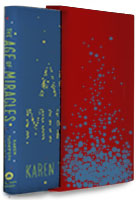
The Age of Miracles

Finished July 31
The Age of Miracles by Karen Thompson Walker

This novel started from a bit of news, one I also had noted and wondered at. The news was that we had to add a second to the year to adjust for a change in the time of rotation. Walker took that idea, and ran with it. In this novel, the change is much more than a second, and it goes on increasing each day, leading to huge societal changes. At the centre of the book is Julia, 11 years old and living in California. Julia finds that relationships change. She has never had a lot of friends, but the change in time leads quickly to changes in her friendships. She also sees it in the relationships of those around her. As the novel progresses and the changes accummulate, we see the effect they have.
Some people try to stick to doing things with the sun, even as the days grow impossibly long and create communities apart from the rest of society. Julia adjusts to doing things in the dark sometimes and sleeping in the light. We see the effect on energy use and food supply. We see how people are trying to find solutions even as they don't know the cause of the "slowing".
I found myself drawn in to Julia and her experiences, particularly those around friendships and her relationship with her grandfather. When she struggles with whether to keep secrets, I identified with her conflicted feelings. Along with everything else, Julia is experiencing her first love, and trying to figure out how to behave about it. She is a very engaging young woman who has interesting observations on the world as it is changing.
I was lucky to get an Indiespensable copy of this, in a nicely boxed edition, which included an interview with the author, providing interesting background to her process in the creation of this novel.
A great read that gets you thinking, what would I do? I think this book would appeal to teens as well as adults.