Showing posts with label Village Life. Show all posts

Wednesday, 31 December 2025

Enchanted Glass

Finished December 8
Enchanted Glass by Diana Wynne Jones

This middle grade fantasy has a great setting, interesting characters, and a plot with interesting elements. 
Andrew Hope's magician grandfather has recently died and left him everything from his house and land to his magical field of care. Andrew, a university professor, moves into the house, but plans to continue his research. The cook/housekeeper and the gardener are vying to see who can get the upper hand in terms of control and both bring in relatives as additional employees as part of this competitiveness. One of them is Stashe, an attractive and efficient secretary and research assistant who also plays a larger role in terms of magic. The other is Shaun, a simple and earnest young man who has mechanical know how and is willing to work hard at whatever job he is given.
When a boy, Aidan, arrives at the house, things begin to get even more interesting. Aidan's grandmother, who raised him, has recently died leaving him in foster care, but she'd given him instructions to seek out Andrew's grandfather should anything happen to her, so he has. Andrew takes Aidan's situation seriously, guarding him from the creatures who seem to be threatening him, and looking for a longer term solution. 
Since one of Andrew's first tasks is to walk the boundaries of the field of care, he asks Aidan to accompany him on this series of outings and they both begin to learn more about their own magical abilities. Andrew also learns of threats to his field of care and the village itself and is determined to keep control. As he learns more about the two stained glass windows on the property, and the way the magic works, he grows into proper adulthood. 
A captivating read. 

Tuesday, 10 December 2024

A Cotswold Killing

Finished December 2
A Cotswold Killing by Rebecca Tope

I've read a later book in this series, but this is the first book in the series featuring widow and amateur detective Thea Osborne and her dog Hepzibah. There is a map in the front that shows the locations of the first eleven books in the series, so you can see how they relate to each other geographically. I would have liked it more if they had also included Thea's town of Witney. She also has a note at the front that indicates that her settings are real places, including the churches and pubs (which are describing in enticing ways as the main character visits them). More personal places like farms and houses are imagined by the author. 
As the book opens, Thea is preparing to go to her first house sitting commission, looking after a small sheep farm in Duntisbourne Abbots, the home of Clive and Jennifer Reynold. The couple are headed off on a cruise. Thea has been widowed just over a year and is still grieving in many ways as we see through the course of the novel. 
When one of her neighbours is murdered on the farm she is looking after on her first night there, Thea finds herself drawn into the life of this secretive village, looking for information on the young man who was killed, his connections, and her other neighbours. 
It helps Thea that her brother-in-law, James, is a superintendent in the West Midlands police. This gives her a helpful reference for her house sitting commissions, and a link to police investigations. She finds that this connection also has benefits for James and his fellow police officers. 
The character of Thea is built with depth here, as we see both her strengths and weaknesses appear as the mystery unfolds. Her dog is a comfort and a companion, a calm presence in most situations. I liked seeing her come to life for me, and found the mystery intriguing

Monday, 13 November 2023

The Bookshop Murder

Finished November 3
The Bookshop Murder by Merryn Allingham

This is the first book in a series of historical mysteries and is set in the mid-1950s. Flora Steele owns a bookshop in the village of Abbeymead in Sussex. She inherited it from her aunt, who raised her after the death of her parents when she was young. Flora had plans for her first few months after getting her library degree, but her aunt's illness and death meant that she is now tied to the store and her life there. When a customer discovers a body in her store, she finds that gossip and rumour are hitting her financial, with a decrease in sales and traffic. With the police not interested in tracking down the reasons this stranger broke into her store, she decides to take matters into her own hands, with the assistance of the crime-writing customer who discovered the body. 
I got a real sense of village life here, and how people were reacting to events of the time, like the end of rationing, and the turnover of traditional manor properties. Flora is a determined young woman, and is unhappy about not being taken seriously. She is full of ideas, but also open to critiques of those ideas with solid facts. One gets a very concrete examples of how women's views and concerns were not treated with the same respect as men's. I definitely got a sense of how the series might continue and how some plotlines might develop further in future books. An enjoyable read. 

Friday, 3 November 2023

Two previous series reads that somehow got missed: Blue Moon by Lee Child and The Golden Tresses of the Dead by Alan Bradley

While following up on some of the series I read, I noticed gaps for two them where I seemed to have missed a book. I've taken them out of the library, but as soon as I started reading them I remembered them. I've searched all my notes and don't seem to have written reviews, which is very odd for me. They both date from the same time period, published in late 2019 read either in late 2019 or early 2020 and I guess that I missed them in the busyness of other things at the time. So here they are, now.

Blue Moon by Lee Child, read by Scott Brick

This is the 24th book in the series and once it again it begins with Reacher on a Greyhound bus in the middle of America. He assists an older man after the man is attacked in the street after exiting the bus, and one thing leads to another as he first helps him to the place where the payment the older man needs to do is to take place, and later to his home. The man and his wife are worried about their daughter whose story unfolds for him. He soon finds himself impersonating the old man, and getting between the Ukrainian and Albanian gangs who run the town and are vying for expansion under the new police commissioner in the small city. 
As each gang makes moves and Reacher makes some to protect himself and the older couple, there is luck that happens, as they say, once in a blue moon. Reacher's investigations lead him into the world of paid healthcare in the U.S., IT startups successes and failures, money trails and extortion rings. 
This is classic Jack Reacher, satisfying for the little guy, with the bad guys in deep trouble. 

The Golden Tresses of the Dead by Alan Bradley

This is the 10th book in the Flavia de Luce series. Her oldest sister Ophelia is getting married as the book opens, but there's a shocking item in the wedding cake when she slices it. Flavia is quick on her feet and manages to take the item while the focus is on Ophelia's hysterics. 
Flavia has also teamed up with her father's valet, Dogger, as a private investigation firm. The wedding discovery turns out to be the start of their first case, leading them to a special railway for the dead, a visit from missionaries, and a client who dies before the case is resolved. 
Dogger serves as a guide for Flavia's enthusiasm, putting her on the right track, and encouraging her good ideas. To their clients and the police they present a team that can put things together faster than the officials can. 
This isn't my favourite of the series, but it does offer some interesting scenes, and cousin Undine plays a larger role than in earlier books. 

Friday, 27 October 2023

The Haunted Season

Finished October 18
The Haunted Season by G.M. Malliet

This cosy murder is set in the English village of Nether Monkslip, where Father Max Tudor is still adjusting to his role in the community and his new role as the father of a young child. Max has a previous life as a spy, and he worries that that life may have followed him to his new one. 
The village is looking forward to the annual duck races, which raises money for worthy causes, including the church, and has asked the local gentry, Lord Baaden-Boomethistle for the use of their grounds for the event, which is reluctantly given.
When the Lord is found dead in a grisly and obviously planned murder, the search begins for the killer, with Max both the man who makes the discovery of the body, and a consultant to the police. 
Max's new curate, Destiny Chatsworth, plays an important role as well, overhearing a conversation in London that references the village, and remembering a personality from her university days. 
The characters and setting are very twee here, with the character names almost overdone. There are also several characters that are stereotypical on the surface, but surprising as one gets to know more about them, such as the avid volunteer Eugenia Smith-Ganderfort, the housekeeper Mrs. Hooser, the retired schoolteacher Miss Agnes Pitchford, and the Lord and Lady of the Manor, along with their adult children. 
This is the fifth book in the series, but the first that I've read and I found the character list at the beginning helpful to place the numerous people. 
There is definitely a touch of wit in this mystery, along with the cosy atmosphere of village life. 

Tuesday, 27 June 2023

The Sibyl in Her Grave

Finished June 17
The Sibyl in Her Grave by Sarah Caudwell (Hilary Tamar, #4)

This mystery is definitely on the odd side. Intellectual and with paranormal elements, it is set around a law professor (Hilary Tamar), lawyers they are friends with in London, and the aunt of one of the lawyers who lives in a small village in England. 
The aunt's story is told mostly through letters to her lawyer niece asking for advice on different legal issues that have arisen in her life, starting with one to do with taxes from investment income. It moves on to what may be murder, a sudden death of an unlikable woman who ran a fortune-telling business, to matters of inheritance, and more. 
There is a side-story of renovation work being done at one of the law firms, and the retirement decisions around an important client at that same firm. 
There is also a mysterious man who appears in the village, that may be a key clue in mysterious death. 
I enjoyed this mystery, with its explanations of legal issues, and the somewhat mysterious professor, who seems to have many contacts with former students. 
It is also interesting that we never know the gender of this professor, with their androgynous name and no other defining information beyond the university they teach at.  
The home of the fortuneteller is a very odd one, with the birds a particularly unsettling element. 
I would definitely be interested in reading more of this series. 

Monday, 7 February 2022

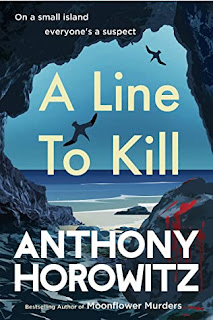
A Line to Kill

Finished January 28
A Line to Kill by Anthony Horowitz

This is part of a series where a fictionalized version of the author, also named Anthony Horowitz, works with an ex-cop turned private investigator, Daniel Hawthorne. He essentially shadows Hawthorne as he investigates a case and writes it up as a book. Hawthorne is reserved, not talking about himself to Horowitz much, and disdainful of Horowitz's intelligence. 
This is the third book in the series, but the only one I've read. I received it as a gift this past Christmas. 
As the book opens, Anthony is having a meeting with his publisher and they want Daniel to come to the meeting as well. He tells Daniel about it, and he comes and makes a favourable impression. They are told about a new literary festival that they've received an invitation to, and even though the newest book isn't out, so they don't have anything to flog, Daniel seems eager to go, so Anthony agrees. 
The festival takes place on the small island of Alderney, and the group of authors is small. They include a TV chef who has a new book, a children's author, a woman who says she can communicate with the world beyond, a local historian, and a French poet. All but the local historian meet as they wait for the plane to take them to the island. 
Once on the island they meet the organizer of the festival and soon after the sponsor, a wealthy casino owner who is also pushing for a planned power line to cut through the island, a project that has significant local resistance. Anthony also discovers a man that Daniel once arrested also lives on the island, and he begins to wonder if that was why Daniel agreed to come. 
As the festival gets underway, and Anthony and Daniel spend more time together, he learns more about this man and his background. 
When someone is found killed, and the local police aren't immediately available, Daniel gets brought in to look at the case, and Anthony comes along with him.
This series is definitely an interesting idea, and one wonders how much the real author resembles this fictional version. The case has lots of people with opportunity and many with motives, but it is a slower read than many mystery books as the case progresses slowly and the characters are mostly shallowly drawn. A decent read. 

Friday, 3 December 2021

The Blackhouse

Finished December 1
The Black House by Peter May


As always with May, I found so much more in this book than just the mystery. The main character here is Edinburgh detective Fin Macleod. Fin was born and grew up on the Isle of Lewis, one of the northernmost and remote parts of Scotland. Fin has been on leave for the past month after the death of his child Robbie. He is called in to be assigned a case, one that the computer system HOLMES has suggested him for. Earlier in the year, he had a case in Edinburgh that wasn't solved. Now a similar crime scene has turned up on Lewis, near where he grew up. 
The case takes Fin back to the island that he hasn't been to in years, since his maternal aunt died. It also takes him back to the people he knew then, the friends, the enemies, the people he loved and the people he hated. And it brings him back to the events that happened shortly before he left the island for university, ones that he still doesn't fully understand. 
Besides the very interesting character of Fin, this book acquainted me with the Isle of Lewis. The details of the landscape are drawn well by May, and provide a real sense of the island, as well as the lives lived there. There is also an event that happens annual that is specific to one village on the island and a small uninhabited island to the north. May relocates it slightly, but the event really happens and has its roots in antiquity. From at least the Iron Age, men from this village have been going each year to the small island and killing birds for food. They go for a couple of weeks, during nesting season and take birds of a specific age. The prepare the birds, plucking, burning off the pin feathers, and preserving them before bringing them home. The island is small and rocky, with precarious cliffs and only one landing spot for boats. There is an unmanned lighthouse with a small helipad, that is maintained a couple of times a year, and the island is otherwise protected by law. 
I found this particularly interesting, and after reading the passages in the book about this event, I found a video showing some of the real men who do this. It is fascinating. 
This book is dark and has much sadness in it, but it is also a book that brings people to the truth, and shows a community in all its complexity. A great read. This is the first book in a trilogy set around Lewis, and I look forward to reading the others.

Friday, 11 June 2021

Who Rescued Who

Finished June 8
Who Rescued Who by Victoria Schade

Elizabeth Barnes is a coder and communications executive who has recently worked at a female-oriented tech company. She reacted with a poor joke when under pressure during an interview and was let go as a result. As she struggles to decide what to do now, she gets a call out of the blue from a uncle she didn't even know existed. Elizabeth's father died a few months ago, and he never told her that he had family back in England. He's also left her with one final task that she can do if she accepts her uncle's invitation.
As a city girl, Elizabeth isn't prepared for lift on a small rural farm, with no Internet access. But she finds that her uncle and aunt are very welcoming, and the backstory that her father never shared with her is one that is meaningful to her. As Elizabeth makes friends, discovers that she can have relationships with animals, and reconnects with art, she also finds that life is deeper than the hectic life she's been living lately. 
Elizabeth's discovery of an abandoned puppy has her making unexpected connections, and spending time with her artist uncle has her rediscovering her own artistic endeavours at a younger age. It doesn't hurt that there are some rather good looking and nice men around the village as well as a great coffee shop for her caffeine fix.
This is a book about a woman who's been lonely for a long time without realizing it until faced with the possibility of genuine connections. 

Friday, 4 June 2021

French Dirt

Finished May 30
French Dirt: The Story of a Garden in the South of France by Richard Goodman

This book is about the time the author spent in a small village in southern France. It was a twelve month period, where he and his girlfriend rented a large stone house (owned by an American couple who had renovated what had previously been a silkworm nursery). He had planned for several months in advance to budget enough money to afford to do this, and they were watching their money carefully. 
At first, they walk around the village and surrounding area, and watch the people, and then they begin to reach out to their neighbours and ask questions and learn about things. 
Richard gets to know the man, Jules, who will help him make a garden of his own (the first he's ever had) when he trades his labour for firewood for the winter. The area is one of many vineyards, most of which get made into supermarket wine, and the wood he gets is mostly old vines, which suit the purpose admirably. His labour is in one of these vineyards, clearing out stones and other impediments to the vines with a group of local farmers. Richard spent his life in large American cities mostly in apartments where he didn't have an opportunity to garden, but he'd been interested since he was a child following his grandmother's gardener around when she visited his parents home near the ocean in the summer. He is in his forties when he has this experience, but it made a huge impact on his life. He changed the name of the village to protect the privacy of the villagers he became friends with over the year, many of whom he remains friends with still.
His Dutch girlfriend Igminia plays a minor role here, and it seems that their relationship didn't last much longer, but the focus of the book is on the village and the garden. He talks about the house, the village, the people that he met while living there, and the garden he created. You definitely get a good sense of the amount of work he put into the garden, visiting it twice daily and spending several hours there. He mostly borrowed the tools he needed, and he had to haul water from a nearby stream, and later, during the hottest part of the summer in August, had to borrow water storage containers and pump water into them from a river with the help of Jules. He asks for advice from his new friends, watches them garden, and works in local gardens as well. 
You can see the love his has for this activity and its results. I really enjoyed this book.

Saturday, 6 March 2021

Death of a Village

Finished February 28
Death of a Village by M.C. Beaton

This is part of the Hamish Macbeth series, set in the Highlands of Scotland. I have dipped into the series, reading them completely out of order. This is the 18th book in the series. 
There are quite a few plotlines happening in this one, making for a fast moving story. The village in question is a remote fishing village named Stoyre, in Hamish's beat. When he decides to go see it, as he hasn't in a while, he finds things very different. People are more quiet and seem very wary. There is a new preacher in town, and Hamish wonders whether he is a powerful speaker, as there seems to be a religious element to the situation. 
Another plotline is Hamish's love life, whether the local reporter Elspeth Grant is a possible love interest, or just an occasional partner in dealing with suspicious situations. 
There is also a local seniors home where one option for residents is to sign away their home for a place to be cared for. More than one local seems to have died shortly after moving in, and an older lady in his village elects to go in to see what is happening. She gets more than she bargained for, but finds an unexpected ally. 
As various other crimes are resolved by Hamish and he gets both media attention and accolades from his superiors, he worries about being promoted out of his comfortable life, and works to find a solution that will leave him where he is, but not jeopardize his job. 
As always, I enjoyed the various plots, and like how Hamish gets along with the various people in his village and isn't afraid to take on a challenging situation. 

Thursday, 24 December 2020

Fire and Ice

Finished December 14
Fire and Ice: Soot, Solidarity, and Survival on the Roof of the World by Jonathan Mingle


This book uses a small village in the Himalayas as a focal point for environmental concerns in a way that makes it even more relevant and personal. Mingle first met the people of the village of Kumik in the Zanskar valley of the Himalayan mountains of north west India in 2012 when he was asked for advice on how to build homes to take advantage of passive solar energy, something he has experience in. The village of Kumik is one of the oldest villages in this part of the world, and depends on water from the glacier above for both its daily life and its sustaining agriculture. But the water has been providing less and less over the years, with the glacier shrinking and most of the remaining meltoff going down the other side of the mountain to other villages. 
The village people have been looking at their options as the fields they plant each year decrease and men work at other jobs, away from the village more and more. They have decided to move the village to a new location, where they can arrange irrigation from a nearby river. They will be building a new village from scratch, and want to do it in a way that takes advantage of things like solar energy as much as they can.
Through Mingle, we see the intricacies of village life, how they depend on each other, and the long history of the social contract "chu len me len chaden" which has neighbours supporting each other with fire and water. Violators of the social system are cut off from both these necessities, putting them in the position of not being able to survive. 
We see his work and his interactions with the villages over a couple of years as they gradually build their new village, have many meetings and make many decisions, and work together for their future.
Mingle looks at why glaciers are shrinking and the role not only of carbon dioxide, but also of black carbon. Black carbon, often appearing as soot has many effects. Not only does it pollute existing glaciers and cause them to heat more and thus shrink more quickly, it also has huge effects on human health (and indeed the health of all living things). Thousands of people die every year due to its effects, all around the world. Black carbon's health effects are seen locally, while its environmental effects are global. Many of the world's poorer countries use cooking and heating fuel that contributes to the production of black carbon, not only through the type of fuel, but also through the way that it is burned, leaving unburned particulates in the nearby atmosphere, both in homes and in the air around communities. It is also an output from the use of diesel fuel, often used for generators in  remote communities, but also transportation around the world. Even in the more developed world, the use of wood burning stoves and heaters contributes to this pollutant. 
I learned that the colour of the flame is a strong indicator of the presence of black carbon as an output.The bluer the flame, the cleaner burning it is. That orange glow we admire is not a healthy sign. 
In many instances this is something that can be tackled even more easily than the issue of carbon dioxide (although that can't be ignored). Development and distribution of cleaner burning stoves and heaters needs investment and government support worldwide. The infrastructure and training to support maintenance of these new units is key as well. The use of local solar generators can be another tool for reducing black carbon. In the developed world, replacing wood stoves with pellet stoves can help this effort. 
I learned a lot from this book, and it gave me hope that we can work together to improve the lot of people, from this small village of hardworking people in the Himalayas to our own communities in cities and suburbs. This recent case of the role of this kind of pollution in the death of a young girl in London spoke to its impact in cities. 
Highly recommended.

Monday, 2 November 2020

Death in Avignon

Finished October 29
Death in Avignon by Serena Kent


This is the second book in the series featuring Englishwoman Penelope Kite. Here, Penelope has settled into her new home and is continuing renovations, painting, getting more bathrooms installed, and tightening the house up before winter comes. She likes that traffic isn't as crazy as tourist season dies down. She is still trying to experience that dinner for two with the handsome mayor of her small town, but things keep arising that cancel their plans. 
When they finally have the date booked, they start the evening by attending a local gallery showing, where four artists are showing their work, all of them represented by the same agent. One of the artists is a British ex-pat, who Penelope fends off the advances of before she gets to the art of the local man that she is there to see. The ex-pat's art is kitschy and not to her taste at all. 
But before the couple move on to their planned dinner, one of the artists has a severe episode, needing CPR before being taken to the hospital. 
As Penelope observes the episode, she can't help but wonder what led to it. Was it a natural event of ill health, or was it brought on by someone wanting to hurt or kill the man? She must reach out again to her former boss for an opinion on the case.
During this time, Penelope's step-children and three young grandsons descend on her home, causing her to step up her timeline for renovations and reflect on the decision to move permanently to France. Her French has improved dramatically and she is feeling more and more like her true self. Her neighbours treat her well, even inviting her to be part of a wedding, and she finds a local group of musicians to play with. 
I liked how her life in France grew, with more friends and activities, and she became more settled. The way she handled the case and her interest in it caused some real issues with her friends and she had to reach out to them in new ways to show her motivations were good ones. I'm really enjoying this series and like Penelope who is finally living the way she truly wants to, not bending to the expectations of others.

Monday, 7 September 2020

The Western Wind

Finished September 5
The Western Wind by Samantha Harvey

This historical novel is not your typical mystery. It takes place over four days in February 1491, in a small English village. The narrator is the local priest, and the main subject of the book is the supposed death by drowning of the village's wealthiest man. I say supposed because there is no body, only the tale of a witness, or maybe more than one witness.
The story is told in a backwards fashion with the most recent day appearing first, and the earlier days coming in reverse order. As the story begins, the dean is present, living in the dead man's house and looking into his death, looking for a reason, for a murderer even. He has told the priest to announce a system of long pardons given for all who make their confession in these four days before lent, a pardon of forty days. Another thing that is important to know is that just before the events of this book, the village had a wedding celebration for one of the women who married a man from a nearby village. She was the priest's younger sister, and his only family, and he genuinely misses her.
As we work backwards over these four days, we see the background of some of the village people: The victim, Thomas Newman; the priest and how he came to be where he is in life; Oliver Townshend and his wife, the couple that had sold off most of their land to Newman over the last few years; the dean's reasons for being in the village so soon after the death. Each of the things we learn adds to the information about Newman's death, the people in the village that he interacted with and who depended on him for their livelihoods, his relationship with the priest, and the priest's relationship with the various village people and the dean. All of these things help the reader to understand what happened, and why it happened and what has happened to bring us to the final day included here.
The information about the confessions is quite interesting, the priest implementing a degree of privacy for this purpose that was unusual for England at the time, based on information that Newman provided from his wider experience. I also found it highly unusual how much of this the priest shared with the dean, and what he withheld.
The writing is excellent and one gets a real sense of the village and the life lived there by the inhabitants, and the precariousness of it all. I found it engrossing.

Monday, 15 October 2018

Where the Wild Cherries Grow

Finished September 29
Where the Wild Cherries Grow by Laura Madeleine

This light novel takes place in two time periods, 1919 and 1969.
In 1919, Emeline Vane, a young woman, is still grieving the loss of all but her youngest brother, Timothy, in the war, and the deaths of her parents. Her father had left the house that they lived in on the coast of England, but no money. Her uncle has agreed to pay for the schooling of her young brother, but is insisting that the house be sold. Emeline is in a state of grief in which she is barely surviving. She is not eating, and for her the house represents the last bit of their family life.
When her uncle arranges for her to be sent away to a rest home in Switzerland, she seizes a moment in the train station in Paris and runs away.
She has no money, and no destination. She only knows that she doesn't want to be shut away for her own good.
In the later time period, Timothy's daughter is seizing a time when her father is very ill in hospital to seek to declare her long missing aunt dead, so that she can sell the estate to a developer. Because of the rush she is in, she goes to the lawyers who have been looking after the estate for all these years, a small firm, where a new lawyer, Bill Perch, is given the task as his first case. Bill goes to the house and finds information there that shows Emeline's state of mind, but there is something about her and the situation that makes him want to do the job right and try to find her if she is still alive.
As Bill follows in Emeline's path, we see him grow into a determined young man, as we see Emeline find a new future for herself that is not so very far from where she left.
A story around grief, love, and faith that hooked me and kept me reading.

La Femme De Gilles

Finished September 28
La Femme De Gilles by Madeleine Bourdouxhe, introduction by Elisa Albert, translated and with an afterword by Faith Evans

This short novel by a young Belgian writer, was first published in France in 1937, and with World War II soon upon the country, her work became largely overlooked. The story is set in a rural area of Belgium, and follows Elisa, a young mother, as she finds that her husband is having an affair.
Her reaction is the story.
Elisa lives near her family, and visits them often, but doesn't have a confiding relationship with them, and shares her pain with no one. She observes her husband and his distracted nature and watches him. She even follows him on one occasion when he leaves the house in the evening, Elisa has two young children and is pregnant with her third. In her time and place, leaving her marriage is not really an option that she considers. Instead, she tries to either redirect her husband's attentions, or wait out this betrayal. She hides her pain, and amazingly even offers comfort to her husband.
This is a story of obsession, of a woman burying her feelings as she tries to hang onto her world.
A poignant story.

Sunday, 13 May 2018

The Grave's a Fine and Private Place

Finished May 11
The Grave's a Fine and Private Place by Alan Bradley, read by Jayne Entwhistle

This is the ninth book in the series featuring Flavia de Luce. Flavia, her sisters, and Dogger have left the family home to fill their days, their home being a sad place at present. Her oldest sister is put out by having to delay her marriage, and all three are unhappy at their aunt's insistence that they move to London. Dogger has suggested the village of Volesthorpe as a distraction, and as the book begins they are slowing being rowed on the river. Flavia has one hand over the side, skimming the water, when the hand catches on something. She imagines it to be a fish, but on examination it proves that her hand is caught in the mouth of a young man, a dead young man.
When she draws Dogger's attention to it, they head for shore, bringing the body with them. And Flavia is engaged in another mystery, a distraction indeed. Once on shore, Dogger assigns Ophelia and Daphne a task to keep them looking out at the river, as he and Flavia move the body to a grassy bank. When Dogger goes off in search of the police, Flavia looks for clues, and finds a few, naturally. As the police arrive, along with the vicar, the family retreats to the nearby inn for lunch. There, the two older sisters bolster themselves with a pint of Guinness and Flavia and Dogger make plans to investigate further.
There are other distractions here including a circus with an aggressive woman owner, and a group of rowdies, an inn landlady with a hidden poetry habit, and a famous actress in her golden years. Flavia befriends a young boy who has done some experimenting of his own, and butts heads with the local police officer.
The sisters grow closer here, something that is nice to see. Flavia also begins a much closer relationship with Dogger, who is more forthcoming about his own knowledge and connections. This book moves in a new direction, but an interesting one it is.

Sunday, 14 January 2018

A Whole Life

Finished January 8
A Whole Life by Robert Seethaler, translated by Charlotte Collins

This short novel the man Andreas Egger from childhood through his life. Andreas came to the village in the Austrian alps in 1902 as a small boy. His mother was dying and sent him to live with his uncle Hubert Kranzstocker, who only took him in reluctantly. One of the regular beatings from his uncle resulted in a badly broken leg that didn't set properly. He was a quiet boy, who worked hard. When he turned eighteen and finally rebelled from his uncle's punishments, he left the farm and began to pick up work from others around the village. He grew up to be a strong man, mostly silent, but honest and dependable. The story of his life takes us through happiness and sorrow, war and peace, love and loss.  The mountains he lives among play a big role in his life. This is a story of a man who accepted what life brought him, but took opportunities as they came. He's a man that one can empathize with. An everyman of a sort.

Wednesday, 26 October 2016

A Great Reckoning

Finished October 23
A Great Reckoning by Louise Penny, read by Robert Bathurst

Armand Gamache is back, and this time in a new capacity, as commander of the Sûreté Academy. As he agrees to take on this new role, he knows the challenges that come with the role. After cleaning up major corruption in the Sûreté itself, he is aware that many of the officers joining the organization have been shaped by their experience in the Academy and what he has seen of their attitude and behaviour worries him. He knows he must make major changes at the Academy to change those experiences. He first looks at the faculty and makes changes, removing some professors and adding others. But he sees the bigger picture as well. He looks at the relationship with the local community and the divisions that have been created. He looks at the larger policing community and where the professors he is getting rid of might end up. He looks at the still unresolved corruption suspicions around some of the people at the Academy. And so he makes choices.
He also makes choices in the acceptances of new recruits. He reviews all the applications and accepts some that the previous head had marked as rejected and rejects some that they would have accepted. And again, he thinks carefully and makes some decisions for reasons that others don't see. 
He tries to both make massive change and to tread carefully, and he doesn't always succeed. It is not an easy task. But he has his family, his community of Three Pines, and the support of respected Sûreté officers and leaders. 
When one of his biggest adversaries within the Academy is found dead, obviously murdered, the case is a tricky one, and the investigation must not only be thorough, but be seen to be thorough. Again, he tries to do that right by making sure an outside investigator is part of the team, but that also proves difficult.
An interesting twist is the subplot around a map that was discovered in the wall of the bistro when renovations were made, and which provides its only mysteries. When Gamache tasks some of the Academy students into learning about the map, its origins, and its meaning, he ends up bringing those students into village life in a move that takes us to the heart of Three Pines. 
This book, as with previous in the series, blurs the line between professional and personal, and between facts and feelings. 

Thursday, 13 October 2016

Thrice the Brinded Cat Hath Mew'd

Finished October 11
Thrice the Brinded Cat Hath Mew'd by Alan Bradley, read by Jayne Entwistle

Flavia is back home in England, but things are not the same. When she arrives home, Dogger meets her at the ship, but at home no one is there to welcome her. Her father is sick with pneumonia in hospital. Too sick for visitors she is told although she yearns to see him. Her oldest sister Ophelia is having relationship issues, and her young cousin Undine is an interesting character addition.
Flavia still relies on her bicycle Gladys to get around between home and the village of Bishop Lacey, and on an errand for Cynthia, the vicar's wife, she discovers a dead body in peculiar circumstances. As she is alone and not pressed for time, she takes the time for a careful inspection of the body and its environs, both of which will help her as she works toward the solution to this crime.
Twice Flavia ventures up to London in search of information, and one of her Canadian friends assists her on that end of things, providing some adult guidance and expertise in some areas.
Flavia also makes use of the telephone to gather information using subterfuge to deal with suspected eavesdroppers. Flavia has matured some here. She is less likely to blurt things out, thinks about how others may react to what she says, and generally is more polite in company than she was previously. She is also more independent, perhaps gained confidence from her solo sojourn to Canada in the previous book.
Things are changing in Flavia's life, and as Dogger says early in the book, not necessarily for the better. I look forward to seeing how Flavia deals with the new challenges this book leaves her with.