Showing posts with label Memoir. Show all posts

Friday, 3 July 2026

Clifford

Finished June 26
Clifford: A Memoir, a Fiction, a Fantasy, a Thought Experiment by Harold R. Johnson

This is an intriguing book, and the subtitle gives you an idea of the scope of the book. Johnson talks about his older brother Clifford, a man who had a major impact on Johnson's entire life. Early in life, Clifford helped him overcome a speech impediment, so important as formal assistance wasn't an option for them in their small northern Saskatchewan community. We get a great sense of what it was like growing up there and how their lives changed when they were forced to move away into a larger community. 
Their father was from Sweden and their mother was Cree, and their father assimilated into the local Cree community. Clifford died in a vehicle accident, and it was a loss to the family and the community and we get a real sense of this here. Clifford cared about people and showed it through his actions. There is humour and there is sadness, but overall we are shown an extraordinary human being. 
The book is framed as Johnson camping near the abandoned house that he and his family lived in when he was young. It encompasses memories, the nature around him, the feelings he has about the loss of his brother, the what-ifs, and the way they move forward.
From the examples of scientific discussions we get a great sense of how Clifford's mind worked, so open to new ideas and being able to connect disparate ideas across subjects. His ideas changed over time as he learned new things. 
Johnson is a true storyteller and this book is a great example. 

Thursday, 1 January 2026

I Remember Beirut

Finished December 11
I Remember Beirut by Ziena Abirached

This graphic novel is a recollection of the author's memories from living in Beirut as a child during the Lebanese War. This is a collection of memories illustrated in simple yet bold black and white drawings. It includes maps that help bring the memories to life by showing the overall setting and urban geography of where she and her family lived. Because there are many memories of daily life from how they shopped and went to school, and the limited movement they did, I got a very good sense of what life was like for them.
The optimism she observed in the adults around here despite their situation comes through and I could see how her situation was normalized in this way. I also found it interesting how one memory leads to another, from the man who drove the neighbourhood kids to the closest stop the bus would come to to his one very long fingernail (with the illustration showing one of the ways he used it) to Florence Griffith Joyner's fingernails. This book flows wonderfully, and I found it insightful.

Sunday, 2 March 2025

Still Life at Eighty

Finished February 27
Still Life at Eighty: The Next Interesting Thing: A Memoir by Abigail Thomas


This is the second memoir I've read by this author, following Three Dog Night, a memoir she wrote after her husband's death. This memoir is about aging, starting as she begins her eightieth year. Abigail doesn't want to relive her life differently, but she finds memories coming to her, forgetfulness becoming more common, and her body failing her at times. 
She has moved from New York City to a house in the Catskills, living with her four dogs, who are also aging. She watches nature both outdoors and as it creeps into her home. As lockdowns from Covid keep her from much social contact she relies on friends and family for support, and finds herself with memories, emotions, and the ability to notice even the small things. 
She writes about aging and its accompanying challenges and emotions, about her losses and small joys. 
This is a lovely book that will have you taking the time to notice the small things in your life as well. 

Wednesday, 5 February 2025

All the Beauty in the World

Finished February 2
All the Beauty in the World: A Museum Guard's Adventures in Life, Loss and Art by Patrick Bringley, illustrated by Maya McMahon

This memoir is both fascinating and informative. The author left a job at the New Yorker magazine after the death of his older brother Tom, and applied to be a guard at the Metropolitan Museum of Art. He worked their for ten years, during which time he worked through his grief, made friends, learned about art, watched people, and learned to be present in his life. 
He includes a plan of the museum's public spaces, and structures his book around them as he works in different sections of the building, and even in one of the satellite buildings the museum has. 
He talks about the art, and lists the art he refers to at the back of the book. He doesn't include pictures of the art, but there are drawings that relate to his words, done by illustrator, Maya McMahon. These drawings give a sense of the art that intrigues. 
Patrick's words are sometimes emotional, and centered on his work at the museum. There are a few references to his family beyond Tom, but it is the art that we see him engaging with, and his fellow guards as they hand off from one position to another, share work, and share experiences. They are from many cultural backgrounds, and this comes into his story as well. 
This was a book I received through a subscription from English bookstore Mr. B's Emporium, and I loved it. 

Friday, 15 March 2024

My Life as a Villainess

Finished February 25
My Life as a Villainess by Laura Lippman

This collection of  fifteen personal essays covers many aspects of Lippman's life, from her later in life motherhood to her time as a rookie reporter in Waco, Texas to the wonder of reheating leftovers in a double boiler. 
The book is organized into four sections, each with a few essays, along with an introduction that tells us how she came to write personal essays in the first place. I came to this book having enjoyed her fiction and found myself quickly enjoying her open style when discussing different aspects and events in her life. As she says in the introduction, there are portions of her life not covered here, but what she has included is interesting and relatable. 
Her opening essay is on the mental struggle for women between the body they have and the body society tells them they should have. It's magnificent. 
The essays aren't in chronological order about her life, but are grouped roughly into four sections where they feel that they belong with each other. 
I read this book one essay at a time, taking breaks between them and found them emotionally moving and reminding me of aspects of my own life. 

Tuesday, 2 May 2023

As I Walked Out One Midsummer Morning

Finished April 23
As I Walked Out One Midsummer Morning by Laurie Lee

This memoir covers from the summer of 1934 to late 1936. 19-year-old Laurie has never left the area of England he grew up in before this time, but he sets off on foot from his home in the Cotswolds heading for London. He has never seen the sea and so decides to go via Southampton, adding about 100 miles to his journey. As he walks he either eats what he has brought with him, what he finds on the land, or what he is given by those he passes by or stays with. He is not the only one on the road, and he at one point he travels with a long-term wanderer named Alf. I have to say that this reminded me of a homeless man I was once acquainted with, also named Alf, and made a connection to this fleeting glimpse of a person. Laurie finds a room in London and a job working construction and trying out various entertainments in the city. After nearly a year, when the building project he is one comes to an end, he realizes that he is free to go anywhere and he buys a one way ticket on a ship to Viga, Spain.
In Spain, he resumes his walking, stopping and playing his fiddle in the streets for what money people are willing to give. He has rudimentary Spanish, and lots of curiosity and he meets a wide variety of people from other travellers to locals from all walks of life. The heat he encounters is one thing he is unprepared for, and he finds himself suffering badly at times. 
We follow him as he goes to Valladolid, on to Madrid, and then to Toledo, stopping for varying lengths of time depending on how people react to his music and where he can afford to stay. He continues south, crossing the mountains into Andalusia stopping in Seville and then going down to the coast. After a brief visit to Gibraltar, he goes on along the coast, ending up in the town of Castillo. He had planned to go further, but at this point the Spanish Civil War breaks out in the area, and he finds himself going to ground there with the townspeople. Soon after, a British warship stops and offers a way out for him and the British writer who has been living there.
There is an epilogue that comes six months later when he finds himself once again at the Spanish border, looking to help those he grew to care about in his journey.
This is a very personal story, that gives a real sense of the world of the time, and the places and people that he met along the way. He wrote it more than three decades after the events contained in the book, with an eye to the bigger picture he didn't see at the time, so one gets a sense of the looming unrest, but it doesn't overtake his personal story. 
An enlightening read with a real sense of place and time. The language is beautifully descriptive. 

Tuesday, 23 August 2022

Summer at Little Lava

Finished August 10
Summer at Little Lava: A Season at the Edge of the World by Charles Fergus

This memoir is of a summer spent in a remote, off-the-grid house on a farm on the west coast of Iceland. The author is still reeling from the sudden and violent death of his mother and hopes that this time will help the healing. No roads lead to the house, and to get to it you must cross a wetland that is flooded twice a day by the tide. It is surrounded by lava fields and has views of mountains, volcanoes, and the rugged coastline. 
Fergus goes in late May and, working with an Icelandic friend does repairs to the abandoned house, making it weatherproof and fitting it with the basics. He and the friend had gone in December to do a reconnaissance and see what would be needed. There is no heat other than the fires that they make, no electricity, and no running water. They use one of the cold pools in a cleft in the lava field as a fridge, and get some supplies locally from neighbours. 
Once his wife and son join him and they buy a used car, they spend the summer exploring the country nearby, including on a collapsible kayak that he brings to have time in the nearby ocean, are visited by relatives undergoing their own healing journey, and enjoy watching the animals and birds and noting the local plants and geology. 
The author's wife Nancy had done graduate work on the Icelandic sagas, they had visited the country a few times together and Nancy had gone again to study the language. It was she who had discovered this farm and they had already planned the visit before the loss of the author's mother. Nancy has also found references to the farm dating back to 1354 and there are the remains of other structures on the property. 
This is a personal memoir of his own emotional journey, but also beautiful descriptions of the land and its occupants. This is a book to savour. 

Sunday, 19 December 2021

Dirty Work

Finished December 16
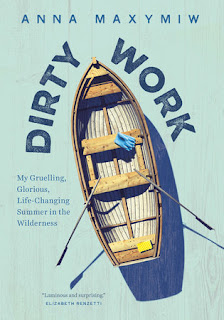
Dirty Work: My Gruelling, Glorious, Life-Changing Summer in the Wilderness by Anna Maxymiw

This memoir of a summer spent as a worker at a remote fishing resort in Northern Ontario is an reflective and open piece on a time that changed the author's perspective on herself and on how she moved forward. Anna grew up in the city, unlike most of the other members on the crew at the fishing lodge and she was working on her Master of Arts, while most of them were engaged in studies to do with the environment or tourism. She had come to the resort the year before as a guest with her family and really enjoyed her time there, so she had some idea of the environment she was entering into and the nature of the work. 
It was however a move outside her comfort zone, pushing her into the company of a group of other young people, none of whom she knew, in close quarters for several weeks. There is no place for privacy, no access to the internet, and little down time. If she wasn't working, she was resting from the very physical work she was doing, too tired to do much. She found herself forming the first real female friendships she had, and engaging with young men in ways she wasn't used to. 
She gained a nickname she didn't love, a realization that she was stronger than she had thought, and a better sense of who she was as a person. 
There were good times and bad ones, and things were tense at times, but her memoir makes it clear that this was an experience she was glad she'd undertaken.