Showing posts with label Norway. Show all posts

Friday, 17 December 2021

Keep Saying Their Names

Finished December 8
Keep Saying Their Names by Simon Stranger, translated by Matt Bagguley
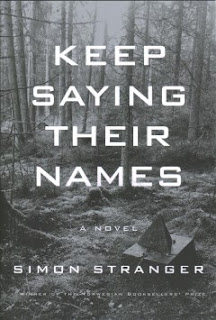
This Norwegian novel was a winner of the Norwegian Booksellers' Prize in 2018 and has a unique structure. It is set in 3 storylines, one modern day, one starting pre-World War II and following a character through his youth into adulthood and his actions during the war, and one starting a few years after the war around a family of Jewish Norwegians. It is structured alphabetically, with each chapter starting with a letter of the alphabet and having statements and discussion around words starting with that letter. I can't imagine how difficult this was to do in translation. This is the first book by this author to be translated into English.
The modern day part of the story features a writer unnamed, who is researching the Jewish family that they married into and what happened to them during the war, occasionally reaching back further, and reaching out to people they were connected with. In particular they are focused on the father of the Komissar family, who was killed in custody during the war. 
The one character, Henry Oliver Rinnan, gets followed from a difficult childhood in poverty, getting bullied and building a desire to be successful and show off that success to those who previously bullied them. This man has that drive to be lauded and to please those in authority, to be a leader, as his driving force. He has no ethics, no sincere feelings for others, even his wife and children, just that need. When the Germans invade in WWII, it is them he tries to please and thus he takes advantage of and betrays so many of his countrymen and women by becoming a double agent for the Nazis.
After the war, when Komissar's son Gerson and his wife move into the house used by Rinnan as a jail and torture chamber for resisters, the history of the house affects their marriage.
This is a story both intimate and national, going deep into people's lives, but also reflecting the history of the country. 

Saturday, 11 January 2020

The Half Brother

Finished January 4
The Half Brother by Lars Saabye Christensen, translated by Kenneth Steven

I've been reading this one for a while and finally finished it. It's a long book, and it took me a while to really get into it. The book starts with a prologue, an interaction between the narrator and his older half brother Fred. This shows us a bit of the relationship between the two and where the power lies. The narrator's name is Barnum, and they live in Oslo.
As the main part of the book opens, we are a long ways into the future from the prologue. Barnum is now an adult and is at a festival in Berlin with his friend Peder where they are meeting with film executives. Barnum receives a message from home that causes him to end his visit early.
The novel now moves further into the past, to 1945, when Barnum's moths is busy with chores as she revels in the end of the war, looking to celebrate with her mother Boletta, and grandmother, The Old One, when she is attacked. This part of the book is about these three women in the family, their loves and their losses. It is from this attack that Fred is born.
Barnum's father is from Rost, a northern island off the coast. But he did not fit the life there and he left as soon as he could. It is only with Barnum's baptism that he and his family return there.
As the book follows the lives of Fred, Barnum, and their family, we see the strange relationship between the brothers, the women that wait for things to happen, and the man who is the father to Barnum.
We also see Barnum begin to develop a life of his own, to find friends and a talent and to grow into a man.
This is a book about the characters more than the action. Slow-moving, but I became more and more interested in them all as I read. More than one character retreats into silence at times, and alcohol also plays a role in many ways, as does film. Fascinating read.

Monday, 30 September 2019

The Faster I Walk, The Smaller I Am

Finished September 11
The Faster I Walk, The Smaller I Am by Kjersti A. Skomsvold, translated by Kerri A. Pierce

This short novel is told from the point of view of an elderly woman, Mathea Martinsen. Mathea has never really had friends and finds it very difficult to deal with other people. She never really talks to anyone except her husband Epsilon. She shops at the quietest time of the day, and when she goes out she waits until the neighbour across the hall has gone out first. She is torn between wanting to have made a difference in the world and not wanting to draw attention to herself.
One day, walking back from the shops, a man standing by the path asks the time, and she is startled and says what she thinks it is. Then she starts wearing her late husband's watch, but the man, even though he is often in the same spot, doesn't ask again. She decides to make a time capsule that will contain information about her life, but she has difficulty deciding what to put into it.
Before he died, she wanted her husband to retire, but he needed time away from her, and she was aware of it. She doesn't have filters really, and says what she feels more than is comfortable for those around her. This is an interesting view of life through the eyes of someone with a very different feeling towards life.

Sunday, 21 October 2018

Hell's Princess

Finished October 2
Hell's Princess: The Mystery of Belle Gunness, Butcher of Men by Harold Schechter

This biography looks at a woman serial killer who operated in small town Indiana in the early twentieth century. Born in 1859 a small town near Trondheim, Norway, she was known in her early life as Brynhild Paulsdatter StΓΈrset. She followed her older sister Nellie to Chicago around 1880, soon adopted a new American name, Bella Peterson. Bella took a job as a laundress and sewer, and began looking for a husband. From the beginning she was more interested in material goods than companionship. Her first husband, whom she married in 1884, was Mads Ditlev Anton Sorenson, a night watchman for one of the large department stores. She seemed to have a maternal instinct, taking an interest in children who were orphaned or otherwise underprivileged. After trying, unsuccessfully, to take custody of one of her sister's children, she adopted an infant in 1891. It is unclear whether the children that followed this one were her own or also adopted.
They managed to invest and make enough to move out to a middle class suburb, but it was an investment in the Yukon Mining & Trading Company, a scam, that caused them to lose much of their hope for the future. Soon after this a fire in their home resulted in another loss, although this time the loss was insured. Mads was a member of an association that provided him with a life insurance policy, and on the day that a new policy took effect (a single day of overlap) Mads died from an apparent illness at home.
After receiving the insurance money, Bella moved to La Porte, Indiana and bought a house and attached farmland. It was this property that Bella used to attract her victims. First among them was a former boarder, Peter Gunness, whom she married in early 1902.
In December of that year, Peter died from a head wound, seemingly from an object falling from a shelf, but some neighbours were suspicious. Soon after Bella began advertising in the Norwegian newspapers read by many immigrants from that country in the U.S. She had correspondences with several men, that indicated partnership and/or matrimony. and many men came to visit, disappearing with no one seeing them leave. Bella's oldest daughter also was said to have left suddenly, to go to a college in California, but none of her friends heard from her.
It was only with the suspicions of two brothers who tracked their third, missing brother's trail, that Bella came to be looked at. Right around then, a terrible fire took her home in the middle of the night, and it was some time before the authorities were able to find the remains of all who had been in the house. As they also began to dig up suspicious looking areas around the property, they found the remains of many bodies, and her notoriety began to form.
A fascinating and scary tale of one woman's greed and daring that took many lives.

Wednesday, 18 February 2015

I Curse the River of Time

Finished February 16
I Curse the River of Time by Per Petterson, translated from the Norwegian by Charlotte Barslund with Per Petterson

This novel is in 1989. The barriers are falling between Eastern and Western Europe, and Arvid Jansen, in his late thirties is in the early stages of a divorce. His mother has just been diagnosed with stomach cancer and has gone back to the land of her youth, Jutland in Denmark, before facing treatment. Arvid chases after her, looking to reconnect with the mother he once had a special relationship with, but has lost over the years.
The story takes place over only a few days, but Arvid's recollections keep taking him into the past. As a child, he was differentiated from his siblings by his physical appearance, looking more like his father than any of his brothers. As a young man with a promising university degree ahead of him, he chose a different route that estranged him from his mother. His idealogical loyalty to the working class led him to reject the opportunities his parents' hard work offered him. The relationship he began shortly after this is a problematic one right from the start.
Arvid is a young man struggling with his life, still looking for approval from the parent he feels closer to, but not showing the maturity that would gain him the approval he wants.
A difficult book, with lots of emotion, but also lots of compassion for human weakness. The relationship between this mother and son is a complex one still.

Sunday, 1 December 2013

Island Summers

Finished November 25
Island Summers: Memories of a Norwegian Childhood by Tilly Culme-Seymour

This memoir covers not only the author's childhood, but the entire family history of this island and what led to her grandmother purchasing it. Tilly has no real memories of her grandmother Mor-mor as she was very young when she died. But she did have access to the recollections of others and of her grandmother's and mother's diaries. The island is located in the south of Norway, with the nearest mainland town, where supplies were often obtained, being Lillesand.
The family lived mostly in England except to come to this island in the summer, a tradition begun in 1947 when Olga Olsen, Tilly's grandmother bought the island and had a cottage and boathouse built on it. The cottage was finished by 1949 and the family began to visit as a group, but Mor-mor always took some time by herself. Both Tilly's grandmother and mother had second marriages, with Tilly being the youngest daughter of her mother's second marriage. The family history is laid out along with the history of the cottage and the family's use of the island. Tilly's mother took on the cottage from her mother with the blessing of her siblings, and the new generation is using it extensively, with Tilly herself loving the off-season when things are quieter, after spending some late winter months there in 2006.
This is an engaging open memoir and the maps and photos help make the island come alive. The stories detail everyday life on the island, and give a sense of how the family dynamics work both now and in the past. A very interesting family memoir.

Tuesday, 30 July 2013

Norwegian by Night

Finished July 30
Norwegian by Night by Derek B. Miller

This novel has an unlikely hero and a plot that grabs you and doesn't let go. Sheldon Horowitz is 82, and has moved to Norway to live with his granddaughter Rhea and her husband Lars following his wife's death.
Sheldon was too young for World War II, but was driven to sign up early for the Korean war. He was a Marine sniper, but told his family he was a clerk. When his son Saul came of age, there was another war, and he encouraged Saul to sign up for his country. As a Jewish-American Sheldon felt that he had a reputation to defend, and that his son should do the same. But his son didn't return from Vietnam, and Sheldon and his wife ended up raising Saul's daughter.
Sheldon's age, his guilt at Saul's death, and his love for Rhea, have all brought him to where he is now. So when he hears a bad argument from Rhea's neighbour, he is moved to do the right thing, and he opens the door and offers sanctuary to the woman and boy who are standing in fear in the hall. But the sanctuary is short-lived, and Sheldon and the boy end up fleeing.
As Sheldon moves between his knowledge of what danger the boy is in, and his own memories and guilt about the past, he relies on his training and instincts to protect the boy and get him to what he believes is a safe place.
The boy's danger comes from Enver, a Balkan man, driven by his own past and trying to cover that past no matter what the barriers might be.
And the police, Sigrid and Petter, are one step behind Sheldon, trying to find him and trying to find Enver and the evidence necessary to bring him to justice.
With humour, suspense, and wonderful characters, this book is one you will not want to put down, as you root for Sheldon to make it, and fear that he might not. A story of love, guilt, and instinct.
I love too that the cover is perfect, drawing from the plot and giving one a sense of the setting.

Sunday, 28 October 2012

Doppler

Finished October 26
Doppler by Erlend Loe, translated by Don Bartlett and Don Shaw

This short novel has been a bestseller in Scandinavia, and I quite enjoyed it. Doppler is a man who has had a sudden realization that he doesn't like people, and has gone to live in the woods. While he doesn't take money with him, he isn't above bartering for things he wants, or stealing them from other people. Doppler sometimes seems completely out of touch with the world, and other times seeing the world very clearly. The cover calls the book "an enchanting modern fable about one man and his moose". And the moose enters the tale very early, becoming Doppler's companion, confidant,and tentmate. As Doppler relates to his wife, children, and the men he encounters, we see both the interactions between them and Doppler's thoughts. I see him as kind of an everyman for the modern time.

Friday, 28 September 2012

Shadow on the Mountain

Finished September 28
Shadow on the Mountain by Margi Preus

This is an historical novel aimed at children, set in occupied Norway during World War II. The main character Espen is 14 when the novel begins and starts out delivering underground newspapers. He then becomes a courier and later a spy. Espen is based on the real life Erling Storrusten.
Most of the story is from Espen's point of view, but some chapters are also from the point of view of another young man, Aksel, who joins the German side and some chapters are from Espen's little sister Ingrid.
The history is interesting, and Preus has done her research here. I would have liked more story as I felt it ended a bit abruptly and before the end of the war. I grew to care about Espen as Preus really gave him depth. The reader gets a real feel for the conditions the Norwegian people lived under and the German power they were up against. Being on home terrain gave them a real advantage, but as some of them joined the German side, that wasn't as effective as it might have been. Despite the odds, the Norwegian people became a real burr in the side of the Germans, and this book shows the ways in which that happened. From subtle refusal to comply to sabotage, the people mounted an effective resistance to their occupiers.
This book particularly interests me as part of my heritage is Norwegian.